


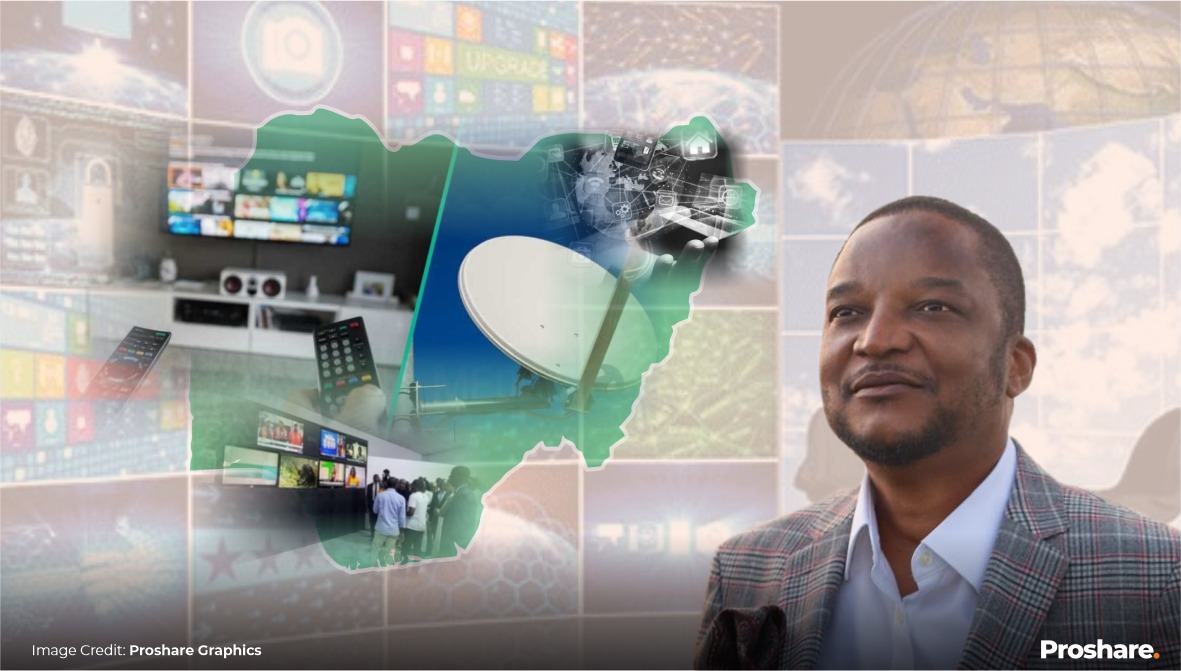

Nigeria’s Digital Switch Over has reached the point at which the decisive question is no longer timing or technology selection but national architecture. This contribution by Anthony Dara, reframes the debate away from a satellite versus terrestrial contest and toward a converged system in which satellite, terrestrial and Internet Protocol delivery each carry the load they are best suited to bear, with digital terrestrial television positioned as the indispensable backbone
For our readership of investors, policymakers, regulators, broadcasters, advertisers, technology providers, and public-sector stakeholders, the significance lies in what architecture determines. It determines market structure, the distribution of platform power, the credibility of audience measurement, the resilience of sovereign communication, and the affordability of household access. It also shapes regulatory certainty around subsisting signal distribution licences, and, with it, investor confidence and capital discipline on which a durable transition depends.
Proshare publishes this article as a timely and governance-focused intervention in the next phase of the DSO debate. The matters it raises bear directly on platform neutrality, fair market access, national infrastructure resilience and the institutional separation between regulation and commercial advantage. We present it as directional intelligence for decision-makers rather than as advocacy for any operator, vendor, or licence position, and we encourage readers to weigh the technical and commercial claims against independent verification.
Nigeria’s Digital Switch Over will not succeed merely because a signal is transmitted. It will succeed only if the country builds the right national architecture: technically resilient, commercially inclusive, institutionally neutral, geographically fair, and capable of combining terrestrial broadcasting, satellite distribution, broadband delivery, mobile reception, regional content, audience measurement and platform economics within one coherent system.”
Nine years ago, I argued that Nigeria’s Digital Switch Over should be understood first as a public-service delivery process. It was not merely a technology conversion exercise, a procurement programme, or a timetable to be announced and revised at intervals. It was, and remains, a national communications project carrying obligations to citizens, broadcasters, industry, government, investors, advertisers and the public interest.
Last week, in my Proshare commentary, I returned to the DSO question from another angle: governance, audience measurement, institutional legitimacy and market confidence. My central argument was that the unresolved challenge had moved beyond transmission. The deeper issue had become whether the emerging digital broadcasting ecosystem is transparent, commercially balanced, institutionally neutral and sufficiently trusted to command long-term industry confidence.
This follow-up addresses the missing bridge between those two positions.
If the first question was public service, and the second was legitimacy, the third must now be architecture.
Nigeria’s Digital Switch Over will not succeed merely because a signal is transmitted. It will succeed only if the country builds the right national architecture: technically resilient, commercially inclusive, institutionally neutral, geographically fair, and capable of accommodating terrestrial broadcasting, satellite distribution, broadband delivery, mobile reception, regional content, audience measurement and platform economics within one coherent system
The architecture question is therefore not an engineering footnote. It is the structure on which the legitimacy, economics and durability of the entire DSO programme will rest.
Beyond the False Choice Between Satellite and Terrestrial
The current debate is too often reduced to a simplistic choice between satellite and terrestrial transmission. That is the wrong framing.
Nigeria needs satellite. Satellite offers national reach, especially across remote, underserved and economically difficult terrain. It can provide a safety net where terrestrial rollout is expensive or slow. It can support contribution feeds, disaster recovery, emergency communication and baseline availability across the federation.
But satellite cannot, on its own, carry the full burden of Nigeria’s digital broadcasting future
A country of Nigeria’s size, climate, population density, urban complexity, regional diversity and mobile-first demographics requires a converged architecture. That architecture must combine satellite, terrestrial and Internet Protocol delivery, with each layer doing what it is best suited to do.
Satellite reaches far. Terrestrial reaches deeply. Broadband extends functionality. The mistake would be to confuse reach with sufficiency.
The engineering question is not whether Nigeria should use satellite. It should. The real question is whether a transition relying predominantly on satellite, while relegating terrestrial to a minor or residual role, can meet Nigeria’s full national requirements. It cannot.
Why the Terrestrial Backbone Remains Indispensable
Tech Investor Resources
A strong Digital Terrestrial Television backbone remains essential for several practical reasons.
The first is climate resilience. Nigeria’s tropical rainfall environment is not theoretical. Heavy rain can affect satellite reception, particularly in Direct-to-Home environments. During intense rainfall, precisely when families are likely to be indoors and television consumption may rise, reception can degrade. Terrestrial UHF transmission is more robust under such conditions and should form part of any resilient national service.
The second is mobility. Direct-to-Home satellite reception requires a fixed dish, line-of-sight alignment and household installation. It is not designed for portable and mobile reception. Nigeria’s audience is young, increasingly mobile, and increasingly oriented toward smartphones, vehicles, handheld devices and shared viewing environments. If the national objective includes reaching citizens where they live, work and move, terrestrial broadcasting and its future evolution toward mobile broadcast capability remain critical.
The third is urban capacity. Lagos, Kano, Ibadan, Port Harcourt, Abuja and other dense markets require high-capacity distribution. Terrestrial networks, especially when properly planned through frequency reuse and Single Frequency Network techniques, can serve dense metropolitan markets efficiently. A national satellite beam, by contrast, shares finite capacity across a broad footprint. For the urban markets where advertising, public communication, entertainment, commerce and national conversation are concentrated, terrestrial capacity is not a luxury. It is an economic necessity.
The fourth is localism. Nigeria is not a single-language, single-culture, single-market broadcast environment. It is a federation of regions, languages, communities, political sensitivities and cultural identities. A mature DSO architecture must support national, regional, state, city and community-facing content. Terrestrial transmission is naturally suited to geographical content insertion. A national satellite beam tends toward uniformity unless additional localisation layers are added
The fifth is advertising and audience measurement. The future of broadcasting is not only about carriage. It is about discoverability, measurement, addressability, interactivity and monetisation. Hybrid terrestrial-broadband television can support audience analytics, interactive services and targeted advertising more naturally than a purely broadcast satellite model. If Nigeria’s DSO is expected to unlock advertising growth, the technical architecture must support measurable, addressable and commercially transparent distribution.
The sixth is national resilience. A national broadcasting system should not be overly dependent on a single point of failure. Satellites have finite operational lives, can suffer technical faults, and require replacement cycles. A distributed terrestrial network provides redundancy through multiplicity. If one site fails, others remain. For emergency communication, public safety, election communication and national messaging, distributed resilience matters.
The seventh is household economics. Direct-to-Home satellite reception typically requires a dish, LNB, decoder and skilled installation. Terrestrial reception usually requires a simpler antenna and a set-top box in areas already covered. For mass-market affordability, especially in urban and semi-urban areas, terrestrial reception can be the lower-cost household access path.
These are not arguments against satellite. They are arguments against architectural over-dependence on satellite.
The Proper Division of Labour
The optimal national architecture should be understood as a division of labour.
Satellite should provide universal reach, remote-area coverage, national safety-net capability, contribution support and backup distribution. It should serve difficult terrain, isolated communities and areas beyond the economic reach of terrestrial expansion.
Terrestrial should provide the national broadcast backbone for population centres, urban and metropolitan capacity, regional content, local insertion, portable reception, mass-market affordability, resilience and future mobile broadcast evolution.
IP delivery should provide catch-up television, on-demand services, interactivity, broadband-enabled viewing, platform extensions, data-driven functionality and digital services where connectivity and affordability allow.
This is not duplication. It is complementarity. The real test is whether the architecture allows each layer to do what it is best at, without forcing one layer to pretend it can solve every problem.
DSO Architecture Is Also Market Architecture
The DSO debate is often discussed as if technology sits apart from economics. It does not.
Market Analysis Reports
Architecture determines market power. Architecture determines who controls signal distribution, platform access, audience data, and discoverability. It determines who controls carriage agreements, who controls measurement, and who determines which broadcaster is visible, measurable and commercially bankable.
These are not secondary matters. They are the economics of the digital broadcasting market itself.
A poorly designed architecture can reproduce analogue-era bottlenecks in digital form. It can create artificial scarcity where digital abundance should exist. It can shift power away from broadcasters into narrow platform-control structures. It can make audience measurement a gatekeeping instrument rather than a confidence-building tool.
DSO Architecture Is Also Market Architecture
The DSO debate is often discussed as if technology sits apart from economics. It does not.
Market Analysis Reports
Architecture determines market power. Architecture determines who controls signal distribution, platform access, audience data, and discoverability. It determines who controls carriage agreements, who controls measurement, and who determines which broadcaster is visible, measurable and commercially bankable.
These are not secondary matters. They are the economics of the digital broadcasting market itself.
A poorly designed architecture can reproduce analogue-era bottlenecks in digital form. It can create artificial scarcity where digital abundance should exist. It can shift power away from broadcasters into narrow platform-control structures. It can make audience measurement a gatekeeping instrument rather than a confidence-building tool.
This is why architecture and governance must be discussed together.
A credible DSO architecture must be open enough to attract broadcasters, advertisers, telecom operators, device manufacturers, data companies, content creators, regional stations, technology firms and investors. It must not leave the industry feeling that access, measurement, monetisation and distribution are concentrated within an opaque institutional environment.
Tech Investor Resources
Fairness is not sentimental. It is market infrastructure.
The Original Policy Logic Was Not Concentration
Nigeria’s original DSO policy philosophy recognised the need to separate content provision from signal distribution. That separation was not cosmetic. It was intended to prevent conflicts, encourage infrastructure sharing, promote neutrality, reduce duplication and allow broadcasters to focus on content while licensed signal distributors handled transmission.
The same philosophy anticipated equitable access, reasonable terms, non-discrimination, regulated oversight and multiple signal distributors. That policy logic remains sound.
The country should resist any architecture that quietly reverses that principle by allowing too much control over transmission, platform access, data, measurement and commercial opportunity to converge within too narrow a structure.
Digital transition should expand the ecosystem. It should not centralise dependency.
Doing Business Guide
The Licensed Signal Distributor Question
If terrestrial remains essential, then licensed signal distributors remain essential.
This point is not theoretical. Nigeria’s DSO framework already contemplated licensed signal distribution operators, including public- and private-sector participation
Licences to two signal distributors, Integrated Television Services Limited (an NTA company) and Pinnacle Communications Nigeria Limited, remain material to any credible discussion of Nigeria’s DSO architecture, unless lawfully varied, withdrawn, extinguished or superseded through a transparent regulatory process.
In the case of Pinnacle Communications Nigeria Limited, the documentary record indicates that the licence, upon acceptance, carried a fifteen-year licence horizon. That fact matters not as a special pleading for any individual operator, but as a question of regulatory certainty, investor confidence and institutional fairness. Where a licence has been granted within a national policy framework, any subsequent architecture that appears to bypass, diminish or commercially neutralise subsisting signal-distribution rights requires clear, transparent and lawful explanation.
But licensing alone is not enough. A signal distributor must be technically capable, commercially neutral, properly regulated, sufficiently capitalised, infrastructure-facing and aligned with the public interest. It must not be reduced to a paper licence, a political label or a dormant entitlement.
The country needs signal distributors that can build, operate, maintain and evolve transmission infrastructure. It needs tower sites, transmitters, multiplexing facilities, monitoring systems, backhaul, power resilience, field engineering, service-level discipline, emergency response capability and regional rollout plans.
It also needs transparent commercial terms. Broadcasters must know the cost of carriage, the quality of service, the basis of pricing, the mechanism for dispute resolution, and the protections against arbitrary exclusion or unreasonable dependence.
If signal distribution becomes technically weak, commercially opaque or institutionally sidelined, the entire DSO structure becomes fragile. A credible DSO architecture must therefore recognise existing licensed rights, clarify current obligations, and integrate capable signal distributors into a transparent national rollout model rather than create uncertainty around the very infrastructure class the original policy framework anticipated.
The Missing National Blueprint
Nigeria now needs a clear public architecture blueprint.
Doing Business Guide
Such a blueprint should answer a defined set of basic national questions. It should establish the intended balance between satellite, terrestrial and IP delivery, identify which areas will be served first by terrestrial DTT and which will rely primarily on satellite, and set out how urban capacity will be managed and how regional and local content will be inserted. It should specify how signal distributors will be regulated and how audience measurement will be made independent, auditable and trusted. It should clarify how set-top boxes, smart televisions, mobile devices and broadband platforms will coexist, how tariffs will be set, how emergency broadcasting obligations will be met, and how the architecture will prevent dominance and dependency.
Without answers to these questions, Nigeria may have activity without architecture, rollout without confidence, and transmission without transformation.
A coherent DSO model should include four integrated layers.
The first layer is the terrestrial backbone. This should prioritise major cities, state capitals, dense population corridors, economically significant clusters and border-sensitive areas.
The second layer is the satellite safety net. This should serve remote, underserved and economically difficult areas, while also providing redundancy, contribution feeds and disaster-recovery capacity.
The third layer is the IP extension. This should support OTT, catch-up television, interactive services, broadband-enabled viewing, educational services, advertising technology and data-driven innovation where connectivity exists.
The fourth layer is the governance and measurement layer. This may be the most important. It must include independent audience measurement, transparent platform rules, clear carriage frameworks, audited data systems, competitive safeguards and institutional separation between regulation and commercial advantage.
Only when these four layers work together can Nigeria claim to have a true digital transition architecture.
Architecture Is Destiny
The next phase of Nigeria’s Digital Switch Over debate should focus on architecture.
Doing Business Guide
Governance matters. Audience measurement matters. Commercial fairness matters. But all of them sit inside the architecture. If the architecture is narrow, confidence will remain weak.
If the architecture is open, balanced and technically resilient, the market will respond. Nigeria does not need to choose between satellite and terrestrial. It needs both.
Satellite reaches everywhere. Terrestrial reaches everyone where they live, work and move. Broadband adds interactivity, on-demand functionality and future-facing services.
The national task is to combine them intelligently, regulate them fairly, measure them credibly, and govern them transparently.
Nine years ago, I argued that the DSO must be treated as public service. Last week, I argued that legitimacy had become the decisive test. Today, I add that architecture is the bridge between the two.
If Nigeria gets the architecture wrong, the DSO may transmit signals but fail the nation.
If Nigeria gets it right, the DSO can become one of the most important foundations for a larger, fairer, more innovative and more sovereign Nigerian media economy.

The issue is no longer simply whether Nigeria will switch over. The issue is what kind of digital broadcasting nation Nigeria intends to become.