


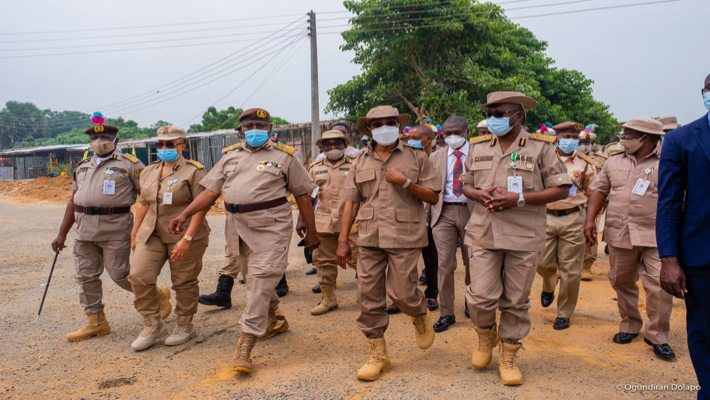

The Nigeria Immigration Service has strengthened its border security through the deployment of advanced technology and enhanced surveillance to curb irregular migration and migrant smuggling across the country’s borders.

NIS spokesman Akinsola Akinlabi disclosed this on Wednesday in Abuja. Mr Akinlabi said the NIS had recorded significant successes in detecting and preventing illegal movement of persons through the nation’s land borders.
He attributed the achievements to sustained border patrol operations and surveillance mechanisms. According to him, border officers have consistently intercepted irregular migrants attempting to leave or enter the country through unauthorised routes.
The NIS spokesman also explained that the service’s Border Surveillance Architecture was designed to monitor difficult and remote terrains that may be inaccessible to personnel.
He said the surveillance infrastructure had enabled the service to identify routes frequently used for irregular migration and strategically deploy assets to such locations.
The NIS spokesman noted that the service’s mandate in the area focused on border security and preventing migrant smuggling, adding that surveillance activities covered both inbound and outbound movements.
He added that irregular migrants attempting to enter Nigeria through illegal routes were often intercepted by border officers and returned to their countries of origin or the locations from which they originated.
Speaking on challenges confronting border management efforts, Mr Akinlabi said irregular migration remained a complex societal issue that required collective action beyond enforcement measures.
According to him, while no border management agency in the world operates without challenges, the federal government has continued to support the NIS by providing critical operational tools and resources.
He, however, said one of the major obstacles was many people’s failure to fully appreciate the risks and consequences of irregular migration. Regarding long-term strategies to sustainably reduce irregular migration, Mr Akinlabi identified technology as a key component of the service’s approach.
He said that while physical border patrols remained essential, technological solutions had become a game-changer in border management.
The NIS spokesman further disclosed that the service, with the support of the Ministry of Interior, had completed the first phase of its e-Border Solution project and was preparing to commence the second phase.
He said the next phase would complement existing infrastructure and further strengthen border surveillance capabilities across the country.

Mr Akinlabi commended the federal government for its continued support of the service, saying the administration of President Bola Tinubu has remained committed to strengthening border security under the Renewed Hope Agenda.