

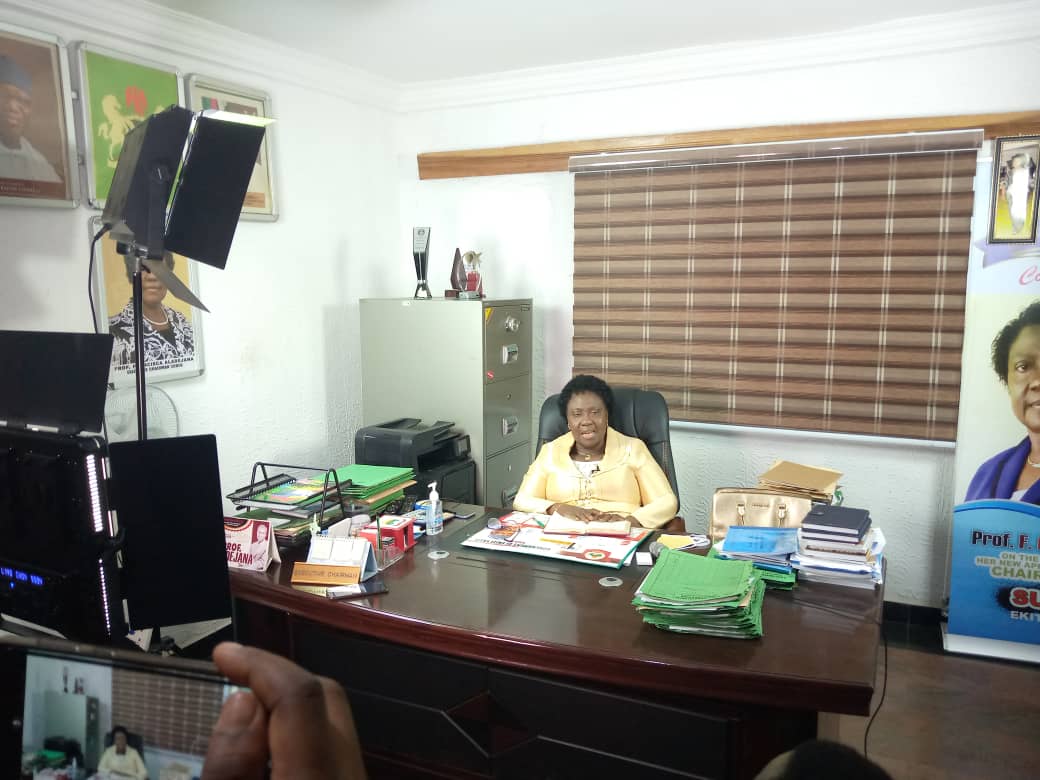

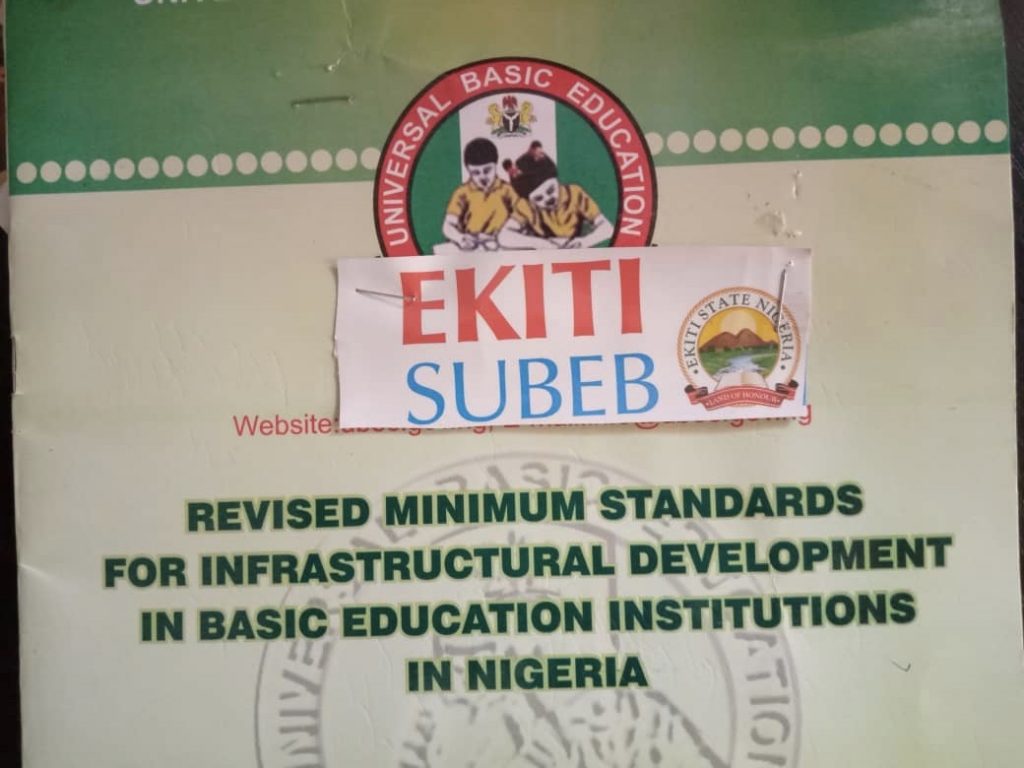
Prof Aladejana a seasoned educationalist who chairs the Ekiti State Universal Basic Education Board during a highly insightful interview session provides detailed information on the collaborative efforts of the state government’s activities in the education section.
Below is the excerpt of the interview session dated Wednesday 12th August 2020
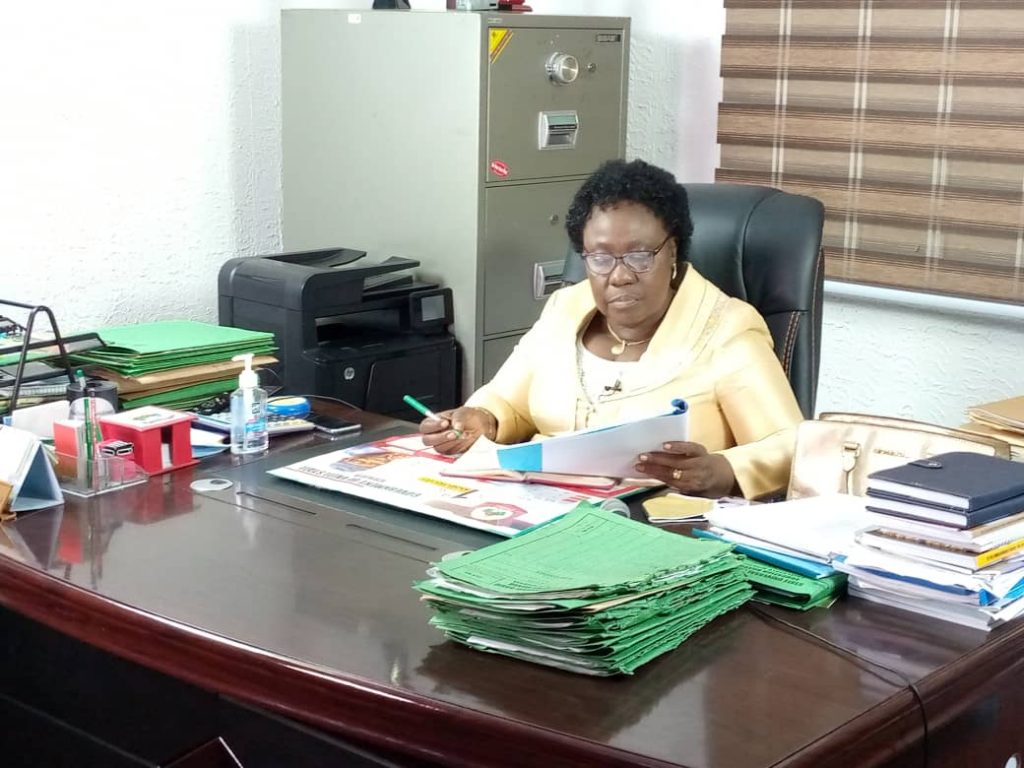
INTERVIEW WITH THE CHAIRMAN EKITI STATE SUBEB PROF. ALADEJANA
INTERVIEWER: Thank you very much ma, for giving us this time on the program, we will be looking at the interventions of the state government through the Universal Basic Education board. Let me just start this way, we know that Education is very critical to this government in fact, the first executive order given by the governor has to do with Education which is the elimination of school fees. How do you think with some other things that had been done especially when it comes to school feeding and the enrollment drive?How do you think this has impacted basic education especially primary education in Ekiti state?
Prof. Aladejana: Thank you very much. I want to appreciate you for interviewing me on Primary Education, actually talking on Basic Education in ekiti state, this gives me very great pleasure to let you know that since the administration of His Excellency Dr. John Kayode Fayemi came on board our enrollment has increased considerably in our public schools, in fact now there is a lot of demand on us now to provide more classrooms because we have more children in our schools and is largely because of all the things that this government has been able to put in place, many of which I will be talking about as we go on in the interview.
INTERVIEWER: Alright ma, we know that it is like a tripod approach in terms of Pupils, Teachers, and also Infrastructure. We talk about the pupils in terms of their enrollment now, let’s look at the Teachers and also in terms of curriculum and all of that, what do you think this government has done so far?
Prof. Aladejana: This government has been able to empower teachers in terms of capacity building, since we came onboard we have been able to have at least 15teacher’s training programs to equip the capacity of our teachers and you will agree with me that you never stop learning, our children are changing and the environment as well. Technology has come to stay so, we have done a lot to build the capacity of teachers and very importantly this government has not failed one month in the payment of our teacher’s salaries, salaries are paid as at when due and so the morale is boosted.They are more encouraged to work and we have made a lot of efforts to improve the school’s environments, to make it more conducive and more safe. We have also provided instructional materials, so all of these together; the totality of these has helped to improve our basic education in the state.
INTERVIWER: Okay now, let’s talk about the curriculum. The state executive just approved the teaching of ICT in Primary and Secondary schools and also, I know that there are some interventions in terms of changing the Curriculum to suit what the government wants to achieve in Basic Education, how far has the thing gone?
Prof. Aladejana: Well, we are happy that even before the advent of COVID, our Governor has been proactive in terms of getting our pupils ICT oriented and that is the basis for the curriculum in ICT. It has been passed and with the coming of the new session we will startoperating it in our schools and for other courses we have various innovations that can make our children learn better introduced in our schools.
INTERVIEWER: Now, let’s look at the Instructional materials; this is also one area which government has contributed in terms of providing apart from physical infrastructures, but also in terms of instructional materials for students to learn within the school environment. How has SUBEB helped in this regard?
Prof. Aladejana: Well, the way we have provided infrastructure, teaching instructional material and teaching and learning materials in our schools has been two ways; there are some that has been fully provided and funded by the state government. Our dear Governor has been able to release funds to us in SUBEB to provide instructional materials and so in our schools provision of Chalk, Exercise books, some of these things that our children need in school, record keeping books have been provided also by the state government.
Secondly, we have had a large supply of material from Abuja and I must let you know that all of these is madepossible because our government has been able to pay the counterpart funding to UBEC. I think it is important to let you know that we were lacking behind in terms of accessing UBEC funding until this administration came onboard and up till date now the government of Dr. John Kayode Fayemi has been able to pay about 7.6 Billion Naira as counterpart funding to UBEC which is a lot when you look At the kind of funding that Ekiti has but it also lends credence to the fact that this government pays maximum importance to the education of its citizens especially Basic education.
So far we have been able to distribute computers, books, story books even to our schools we’ve distributed solar panels, generators so that they can use their computer sets. All of these we’ve been able to distribute, and then core text books.
INTERVIEWER: Now let us go to the core infrastructure in terms of buildings and I know that SUBEB has done a lot in terms of infrastructure, first of all we have gone around and some of the projects has 2016 some has 2017 and 2018 so what happened in those years that the projects were not carried out?
Prof. Aladejana: well this JKF school administration inherited a backlog of project funding that we didn’t access in Abuja, it was not until we came on board now that we accessed 2014/2015 intervention. So if you go out you will see some of our projects labelled 2014/2015 and we are also now accessing 2016/2017 intervention funds, five years together and it is because this government now has been able to pay the counterpart funding backlog and so we’ve been able to access a lot of money and that’s why we are doing a lot of work in terms of improving infrastructure in our schools.
INTERVIEWER : Now let’s go to infrastructure what kind of interventions are we looking at and what is the amount of work going on?
Prof. Aladejana: we have the interventions we are carrying out largely in Seven areas; we have construction of new buildings and presently now from 2014 to 2018 we have now unveiled 319 ongoing projects including buildings, construction of 319 new buildings and amongst this we have 4 big model schools, Mega schools, 18 classroom structures which are really very innovative at the instance of our dear Governor.
For the security of our schools we are also providing perimeter fences and now we have ongoing andcompleted projects, we have 213 perimeter fences this is largely to secure the environment of our schools and also prevent incursions, and they keep our facilities safe. We are providing water system toilets, conveniences for our children and in our schools now we have 219 ongoing and completed. We are also providing water, so we are making boreholes in our schools so we have 105 fairly completed boreholes in our schools. A major work that we are doing right now that we must give the credit to the governor is that he is insisting that he doesn’t want us to keep building new schools while the old ones we have are dilapidating so, we have shifted our emphasis actually to renovation. People are wondering…, we are renovating so that students are not in schools and buildings will fall on them and I must tell you that this administration inherited a whole lot of dilapidated school buildings about over 1,400 that we inherited but presently now we are renovating about 423 blocks of classrooms ongoing, some of them has been completed, some with 3 classrooms, 4 classrooms, 6 classrooms so by the time that our children resume by September we are sure that they will have fairly good environments to start work with, even though we still have a lot of work on ground but we have really hit the ground running. We are also providing furniture into our classrooms, and we have two types of furniture we are providing; Pupil’s furniture and this time we are making use of plastic and so far now we are providing 23,216 pupil’s furniture that’s desk and chair. For teacher’s furniture we are providing 8,045 that is for teachers and then lastly, we are providing equipment for our early childhood section and this is largely in form of Swings and Merry-go-rounds I’m sure you would have seen a few of them on ground and for those, we are providing now 1,479 and to mention also that we are also not taking chances we’ve gone round our schools and we’ve seen some “1920” buildings that are just lying there not functional so, we are demolishing about 500 of such buildings. This is in summary what we aredoing in our public basic education institutions that is;primary and secondary schools and all of these courtesy of the fact that our governor has been able to pay counterpart funding to UBEC and the good news is that we are now ready to start 2019/2020 because he has again paid now 3 billion to access 2019/2020 funding.
INTERVIEWER: This is huge, in terms of supervision of this projects that are spread all over the state how do you ensure the quality of the project? How do you do the supervision of these projects?
Prof. Aladejana: In supervision we have a major section in SUBEB and I want to let you know that when UBEC is giving us funding to build she makes special provision for monitoring so this section as I amtalking about all these projects has provided us with 4 vehicles for monitoring in addition to what we had on ground so we go out on regular basis for monitoring and occasionally at least once in 2 weeks the wholemanagement will go out again to monitor and apart from this the governor is not also taking chances, he has his own monitoring team in his office so those people also put us on our toes because we know that he will go out and our governor’s team is also coming, so there is a special team from the governor’s office that is also doing the monitoring. The Bureau of Public Procurement as part of their oversight function is also monitoring so the monitoring is very broad and off course we have been going round to monitor these contractors whoever we find wanting we correct and if you don’t take to the correction the governor has not minced words to make us know that if any contractor is not delivering using low standard materials, not building according to specifications this governmentwill not hesitate to blacklist such a company and take any other appropriate step to serve as deterrence.
INTERVIWER: So far are you satisfied with what theyare doing and in terms of delivery of jobs do you think they are going to deliver to time?
Prof. Aladejana: Well, we think so, we are already having completed jobs already and we are monitoringthat they will complete on time even our model schools we have assurances from contractors that they will deliver, we have a set deadline for September and we are looking forward for them to delivering on time, and in terms of satisfaction with the quality of jobs, to a large percentage I will say Yes. You know with the kind of people around some will still want to cut corners but we are on their necks and our target is to get them to deliver the best, all of them.
INTERVIWER: I know that this stops directly under the purview that I am talking about technical educationbut there is a link between technical education and basic school education because at the end of the day student move from these schools to technical schools. Is there a way that they are been prepared, if these students don’t go to Universities they can go to technical schools?
Prof. Aladejana: Well in the basic education we have technical education so in our JSS we have technology and basic technology education, so this is like exposing them. Now you know what our basic education is doing is exposing them to all fields, they are exposed to Science, Social sciences, Arts, to Technical education to Agric education to let you know that now we have funding to have school farms in our schools, even to sports we now have funding for sports exposing our children also top sporting activities and athletics. It is an all round exposure that we are giving our children and it is our hope and believe that at the end of basic education a child has already develop specific interest in some areas and so cannot be difficult to say a child I will like to then move to technical education.
INTERVIEWER: Lastly, one of the five pillars of government of this administration is knowledge deployment; do you think the government is providing the basis for advancing Basic education?
Prof. Aladejana: We are doing it in a wonderful way, the passion, commitment, and dedication of government is there, you know that if there is the political will it’s so easy to work and good for us in SUBEB we have a strong political will of the government for us to achieve and it is impacting on our schools with the special zeal of our governor there is a special model college that has been given to the state apart from that of our normal intervention so, a lot of things are coming to Ekiti we are even privileged in Ekiti to access other things that’s courtesy of the good relationship that our governor has with the federal government.
INTERVIEWER: Let’s talk about maintenance because that’s also a problem, we can see very good schools all around, well painted with infrastructure but we also know that we have problem with maintenance. How do you ensure the maintenance of some of these structures that are put in place?
Prof. Aladejana: Well, the maintenance was poor in the past and largely because teachers didn’t get regular running grants for their schools but the good news again is that this administration, the JKF administration now pays regular running grants to Head Teachers and Principals to maintain the schools and on a regular basis now I have had course to let my Head teachers know that if you have just an iron sheet blown off get it fixed, if you have a PVC falling down fix it immediately, before it becomes large and I am sure they know now that they must maintain these buildings and that we will hold them responsible for these buildings we hand over to them?
INTERVIEWER: Is there any way that the COVID-19 has affected any of your operations?
Prof. Aladejana: COVID-19? Yes, Yes, Yes! The impact of COVID-19 has been enormous if you know that we were about to end second term in March when we close down, and knowing that 3rd term now is gone, this has a major impact on our learning but again I want to let you know we were one of the first states to start school on air, on radio for our children at home, and we are still running it, still ongoing where we teach the five basic subjects and some early childhood Phonics to our children every day, we also make it participatory so that after teaching they can ask questions, take assignment home, and we find away to monitor. We are now even moving higher with the program because we have special funding now to continue on air and the way we will even expand the horizon of it, the way we do it now we ensure that students take write downs and when schools finally resume we will be checking the exercise books. We will also be moving to television, we have kept the children engaged in spite the lockdown.
INTERVIEWER: Are you also preparing for the post COVID-19 life especially for students?
Prof. Aladejana: We are really preparing, in fact we are more than prepared already because I can conveniently tell you now that sanitizers, buckets, hand washing soaps, toilet papers and all of these things we need to put in our schools are ready for all our primary schools and then invited Head teachers to interactions on how to arrange schools, space schools, get students to school…we’ve done that interactions with the head teachers and now have some funding that we will be doing COVID-19 training about how do you manage your school having one of our Universities as facilitators and in collaboration with the Ministry of Health, we hope again to do that before student resume.
INTERVIWER: Thank you very much ma, let me just ask, what will you like to tell the parents, some are apprehensive about going back to school and all of that what type of assurance do you offer from Ekiti state?
Prof. Aladejana: We want to just encourage our parents that this government, our governor is very much passionate about the health and welfare of all the children. He has even personally gone out to inspect the schools if they are ready, so he is not going to allow children to come into any danger, we are adequately prepared to take good care of these children when they are with us. I want to also encourage parents to please also maintain the COVID-19 guidelines ion the homes for the children so that no child brings infection to the school but at our own end we are prepared in fact already the Ministry of Health has trained focal personson this COVID-19 for all the local governments to help again to sensitize other teachers. So we are ready.
INTERVIEWER: Thank you very much ma for this time.

Prof. Aladejana: Thank you very much sir