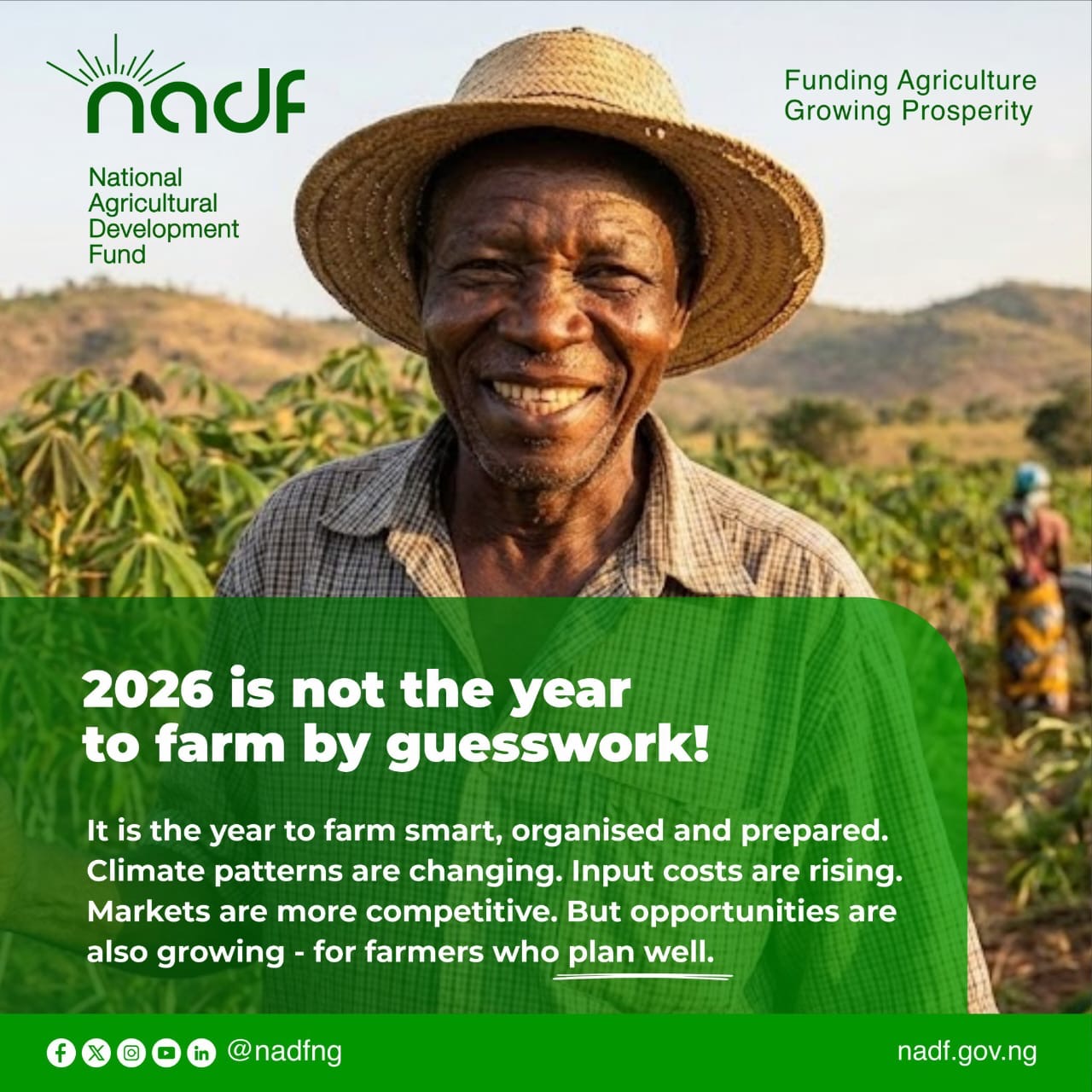




FUNDING NIGERIA’S AGRICULTURAL FUTURE
Moderator: Can you help us understand NADF’s broader mandate and how it aligns with and supports the administration’s food security agenda?
Mohammed A. Ibrahim:
Executive Secretary/ CEO (National Agricultural Development)
The NADF is a relatively new government agency. It was established following the signing of its enabling Act into law in October 2022. I assumed leadership of the agency in November 2023, so it has been just over two years since our operational work began.
Fundamentally, the NADF is designed as a sector-specific development funding institution. This means our role goes beyond traditional financing, we are intentional about balancing both commercial viability and social impact in all our interventions.
While we work to expand access to finance for our teeming farmers and agricultural stakeholders, we also remain deeply committed to ensuring that our efforts deliver meaningful social outcomes.
Since the declaration of a state of emergency on food security, the government has clearly outlined a strategic direction for the sector. The approach began with targeted market correction measures, aimed at stabilizing supply and pricing.
Today, we can say we are transitioning into a market stabilization phase, with the next critical step being sustained growth, not just for the agricultural sector, but for the broader economy as well.
Food security, therefore, sits at the heart of this long-term vision.
NADF’s Financing Strategy and Priority Areas
Moderator:
Food security is far more complex than many people realize. It involves multiple layers and interconnected factors.
Given NADF’s role as a specialized intervention agency, how are these different areas being addressed, particularly financing, which remains one of the biggest challenges for farmers?
Mohammed A. Ibrahim:
You are absolutely right, finance is one of the most critical constraints in the agricultural sector.
However, it is important to clarify that the National Agricultural Development Fund (NADF) operates as a wholesale lending institution. This means we do not provide direct credit to farmers. Instead, we channel funding through Participating Financial Institutions (PFIs), which then on-lend to agricultural stakeholders.
In line with this structure, we have developed two flagship financial products:
- The NADF Wholesale Lending Product
- The NADF Blended Finance Product
Through these instruments, we are able to catalyze financing across multiple agricultural value chains, including poultry, rice, maize, and critical infrastructure within the sector.
Strategic Direction: The Five-Year Roadmap
Before going deeper into specific interventions, it is important to understand our broader strategy.
We have developed a five-year roadmap that guides our operations. While our mandate spans the entire agricultural value chain, we have deliberately identified priority areas to ensure focus, efficiency, and measurable impact.
- Agricultural Inputs (Priority Pillar)
Our first focus area is agricultural inputs, where we have prioritized:
a. Seed Systems
Seed systems are fundamental to agricultural transformation.
Unlike factors such as weather or soil conditions, which are largely beyond human control, seeds are a controllable input that can significantly improve productivity. Historically, most agricultural revolutions have been driven by advancements in seed technology.
b. Fertilizer
Fertilizer is one of the most commercially significant inputs in agriculture.
In many value chains, an Economics of Production (EOP) analysis shows that fertilizer can account for 60–65% of total input costs.
This makes it a critical leverage point for improving both productivity and profitability for farmers.
- Agricultural Infrastructure (Priority Pillar)
Our second major focus area is agricultural infrastructure, with a strong emphasis on:
Post-Harvest Loss Reduction
A significant portion of agricultural output in Nigeria is lost after harvest, due to inadequate storage, poor logistics, and limited processing capacity.
By investing in infrastructure such as:
- Storage facilities
- Cold chain systems
- Processing centers
we aim to reduce losses, stabilize supply, and improve farmer incomes.
Key Takeaway-
NADF’s approach is not just about injecting funds into agriculture, it is about strategically targeting the most impactful levers within the value chain.
By focusing on:

- Inputs (seeds & fertilizer)
- Infrastructure (post-harvest systems)
- Structured financing through PFIs
the Fund is positioning itself to drive sustainable food security, economic growth, and sector-wide transformation in Nigeria.