



In governance, focus is not merely a virtue; it is an economic strategy. When a government concentrates its energy on the critical pillars of development, the results often appear gradually but later, powerfully, creating a ripple effect across the entire economy. Economists describe this phenomenon as the multiplier effect, where a single investment stimulates multiple layers of productivity, income, and growth.
This principle is becoming increasingly evident in Ekiti State under the leadership of Biodun Abayomi Oyebanji. Penultimate Wednesday, this week, the Governor and the State Executive Council approved funds for the rehabilitation of key arterial roads within Ado-Ekiti, with another phase expected shortly. On the surface, to the people, this may appear as a routine government decision, but the economic implications run far deeper than it appears.
Urban arterial roads are the lifelines of commerce. They determine how efficiently goods move, how quickly services are delivered, and how easily people access markets, workplaces, and institutions. When these roads are rehabilitated, the immediate effect is improved mobility, but the secondary effects are even more significant. Transportation becomes faster, businesses expand their operational reach, and investors gain confidence in the economic environment.
Beyond the capital city, major inter-city road corridors are also witnessing remarkable progress. The first phase of the Ado–Akure Federal Road has been completed, significantly easing movement between Ekiti State and Ondo State. The Ado–Ifaki Road has also been completed, restoring a vital economic route linking communities and commercial centres. Meanwhile, work continues steadily on the Ado–Ikare Road, another strategic artery strengthening trade connections and regional mobility. Each of these roads is more than an infrastructure project; they are economic corridors that encourage trade, reduce travel time, and stimulate commerce along their routes. Markets grow where roads improve, and businesses flourish where accessibility increases.
The same philosophy is evident in the administration’s focus on the health sector. Investments in health facilities and services do more than provide medical care; they strengthen the productivity of the workforce. A healthy population translates to fewer lost workdays, stronger labour participation, and a more resilient economy.
Agriculture remains one of Ekiti’s most powerful growth engines. The emphasis on agricultural production and value-chain development reflects an understanding that agriculture must evolve beyond subsistence farming into a dynamic agribusiness ecosystem. When farmers gain access to processing facilities, storage, logistics, and reliable market routes, the entire agricultural economy expands. A critical driver of this transformation is the rural road programme facilitated through the World Bank-supported Rural Access and Agricultural Marketing Project (RAAMP). Across several rural communities, these roads are opening up previously isolated farmsteads and agricultural clusters, allowing farmers to transport their produce more efficiently to urban markets. The implications are far-reaching: reduced post-harvest losses, better earnings for farmers, more stable food supply in urban areas, and expanded opportunities for traders, transporters, and agro-processors.
In further demonstration of this agricultural focus, the Ekiti State Government, in collaboration with the TRACE Project, recently presented irrigation kits worth ₦10 million to Cocoa farmers across the State. This strategic intervention is more than a symbolic gesture; it represents a deliberate investment in agricultural resilience. Cocoa farmers, who remain critical players in Ekiti’s agrarian economy, now have improved access to irrigation support that will enhance productivity, stabilize yields during dry seasons, and strengthen the cocoa value chain within the State. Such interventions signal a deeper understanding of modern agricultural economics: when farmers are empowered with technology, irrigation support, rural access roads, and market connectivity, agriculture moves from survival to profitability, and when agriculture becomes profitable, rural prosperity expands, employment grows, and the broader economy becomes more balanced and inclusive.
These interactions circulate income across the economy and reinforce the multiplier effect that ultimately strengthens the State’s Gross Domestic Product. This is the quiet architecture of economic growth. It is not built on political noise but on thoughtful investments in infrastructure, agriculture, health, and rural connectivity; sectors that form the backbone of sustainable development. In many ways, this is what focus as statecraft truly represents: the discipline of aligning policy, infrastructure, and economic opportunities to build a resilient future.
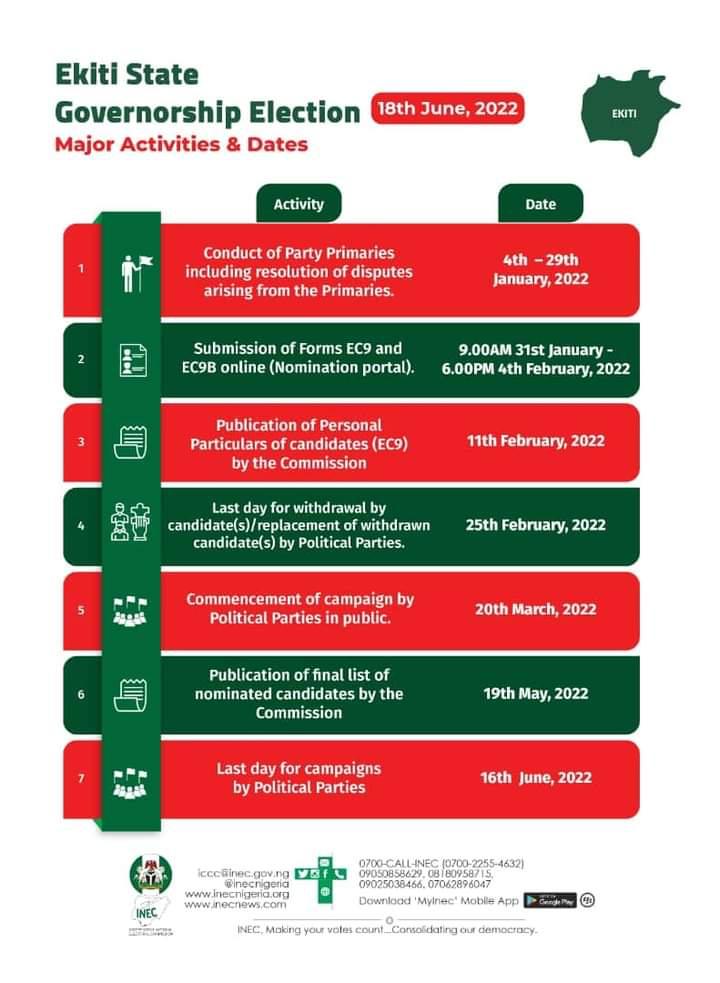
As Ekiti approaches the June 2026 Governorship Election, the people stand at an important threshold. The progress already unfolding across the State demonstrates that continuity in focused leadership can deepen these gains and expand them to every corner of the State. The task before the people, therefore, is clear. Let Ekiti people rally with renewed conviction behind the leadership of Governor Biodun Abayomi Oyebanji. Let us strengthen the mandate that has already set the State on a path of steady progress, and let us, through our fuller support at the polls, affirm that the work of building a stronger and more prosperous Ekiti has to continue. For when a government is focused, and the people stand firmly behind that focus, that development becomes not just a promise, but a shared destiny.
Definitely, and without an aota of doubt, BAO is the man, and APC is the Party
Ekiti a gbe wa!

By Lanre Ogunjobi