



According to the results of the June 20, 2026, Ekiti State governorship election, only 36.07 per cent of the state’s 1,059,360 registered voters turned out, the second-lowest voter turnout ever recorded in a governorship election in the state.
The figures show that only about four out of every ten registered voters cast a ballot, and roughly three of those ten voted for Governor Oyebanji.
The Ekiti election resulted in the re-election of Governor Biodun Oyebanji of the All Progressives Congress (APC), making him the first incumbent governor to secure re-election since Ekiti State was created. Announcing the results, the Independent National Electoral Commission (INEC) Returning Officer, Professor Adenike Oladiji, said Oyebanji secured 319,224 votes across the state’s 16 local government areas. His total was more than seven times that of his closest challenger, the Peoples Democratic Party’s (PDP) Wole Oluyede, who polled 40,543 votes.
Despite the scale of the victory, the election was marked by widespread voter apathy. Only 30.14 per cent of registered voters voted for Governor Oyebanji, while 5.93 per cent voted for other parties. More than 63 per cent of registered voters did not participate in the election at all.
The implications are significant. Governor Oyebanji will govern a state with an estimated population of more than 3 million people and make decisions that affect healthcare, education, security, infrastructure, and economic development. Yet, his electoral mandate was secured by votes equivalent to just 10.6 per cent of the state’s estimated population.
Ahead of the election, INEC’s Resident Electoral Commissioner in Ekiti State, Dr Bunmi Omoseyindemi, announced that voter education campaigns had been expanded across all 16 local government areas to address political apathy and encourage participation. However, those efforts were insufficient to persuade even half of registered voters to cast a ballot.
Historically, the lowest turnout in an Ekiti governorship election was recorded in 2009. However, that election followed an unusual political and legal process. After challenging the outcome of the 2007 governorship election in court, Kayode Fayemi successfully overturned Segun Oni’s victory, leading to a rerun that ultimately altered the state’s electoral calendar and placed Ekiti among Nigeria’s off-cycle election states.
Excluding that exceptional circumstance, the 2026 election stands out for setting a new record in voter disengagement. It was conducted with the largest voter register in the state’s history, yet it recorded the lowest turnout ever for a standard four-year governorship election.
Nigeria’s Off-Cycle Elections Trend
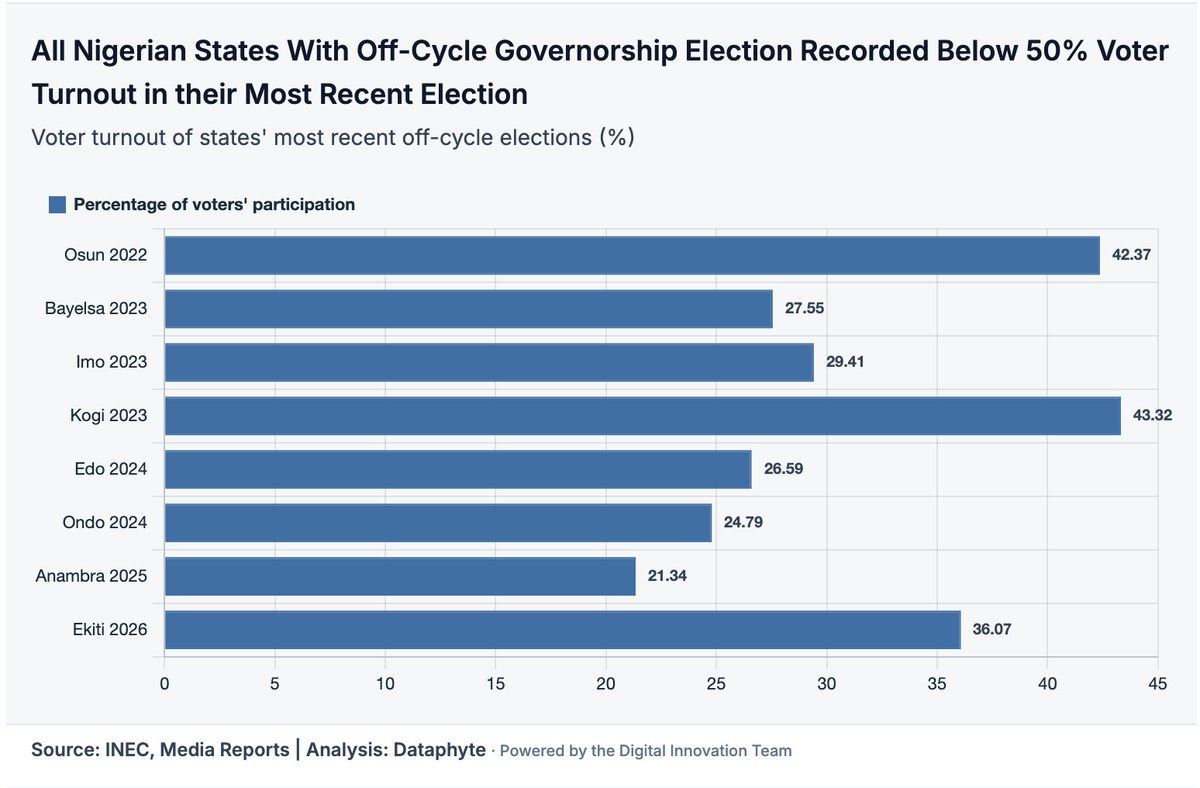
Ekiti is one of eight Nigerian states that conduct off-cycle governorship elections, alongside Osun, Ondo, Kogi, Bayelsa, Edo, Anambra, and Imo. Across these states, voter participation in their most recent elections was below 50%.
Data from recent gubernatorial elections show that only two of the eight states recorded turnout rates above 40 per cent. Ekiti ranks third with a turnout rate of 36.1 per cent, while the remaining five states failed to reach the 30 per cent mark.
The trend suggests that low voter turnout is not unique to Ekiti but reflects a broader pattern across Nigeria’s off-cycle election states.
Vote-Buying Allegations Overshadow Poll
The Ekiti election result reinforces a pattern already evident across off-cycle states: efforts to increase voter participation continue to struggle against deep-rooted voter apathy.
Despite extensive voter education campaigns by INEC and repeated assurances of electoral preparedness, turnout remained low.
The election was also marked by allegations of vote-buying and voter inducement. Reports from observers suggested that inducements allegedly ranged from food items such as bread and pounded yam to cash payments of between N5,000 and N20,000.
On the eve of the election, a video widely circulated on social media showed a campaign bus identified by observers as belonging to the APC distributing loaves of bread to residents. Dataphyte observers also reported that party agents were seen offering incentives to voters at some polling units.
Speaking after casting their votes, PDP candidate Wole Oluyede and ADC candidate Dare Bejide separately alleged incidents of vote-buying, voter bribery, and intimidation during the election. Governor Biodun Oyebanji, however, dismissed the allegations, maintaining that the election was peaceful, smooth, and largely free of vote-buying.
Findings from the Ekiti State Off-Cycle Governorship Election Pre-Assessment Report had earlier identified voter apathy, distrust in the electoral process, and limited confidence in political actors as major barriers to participation. The 2026 election appears to have reinforced those concerns.
Assessing the Quality of the Election
Reacting to the election on Arise News, the Director of Programmes at YIAGA Africa, Cynthia Mbamalu, argued that Nigerians have become accustomed to accepting low electoral standards.
According to her, peaceful elections should not automatically be considered successful elections if fundamental democratic standards are compromised.
“We have normalised impunity and grown used to mediocrity in our electoral system. Even when basic standards are not met, people excuse it simply because the election is peaceful,” she said.
Similarly, a midday election report released by the Centre for Journalism Innovation and Development (CJID) described the election as largely peaceful but noted incidents of harassment of observers, vote-buying, and ballot-guarding by party agents in some locations.
The African Action Congress (AAC) also rejected the election outcome. The party’s chairman in Ekiti State, Makinde Folorunso, alleged widespread vote-buying, voter intimidation, and other irregularities, arguing that these undermined the credibility of the exercise.
Shortly after the election, Mr Folorunso said the party would challenge what he described as a process that had become “a mere facade of democracy.”
The 2026 Ekiti State governorship election produced two records. Governor Biodun Oyebanji became the first governor in the state’s history to win re-election immediately after completing a first term. At the same time, the election recorded one of the lowest levels of voter participation in Ekiti’s democratic history.
In the 27 years since the state’s creation, no gubernatorial election has attracted participation from even half of registered voters. The 2026 election continued that trend, with nearly two-thirds of registered voters staying away from the polls.

The result leaves Ekiti with an electorate that remains increasingly disengaged from the voting process. Whether future elections reverse this pattern or deepen it further remains one of the biggest questions facing Ekiti’s democracy.