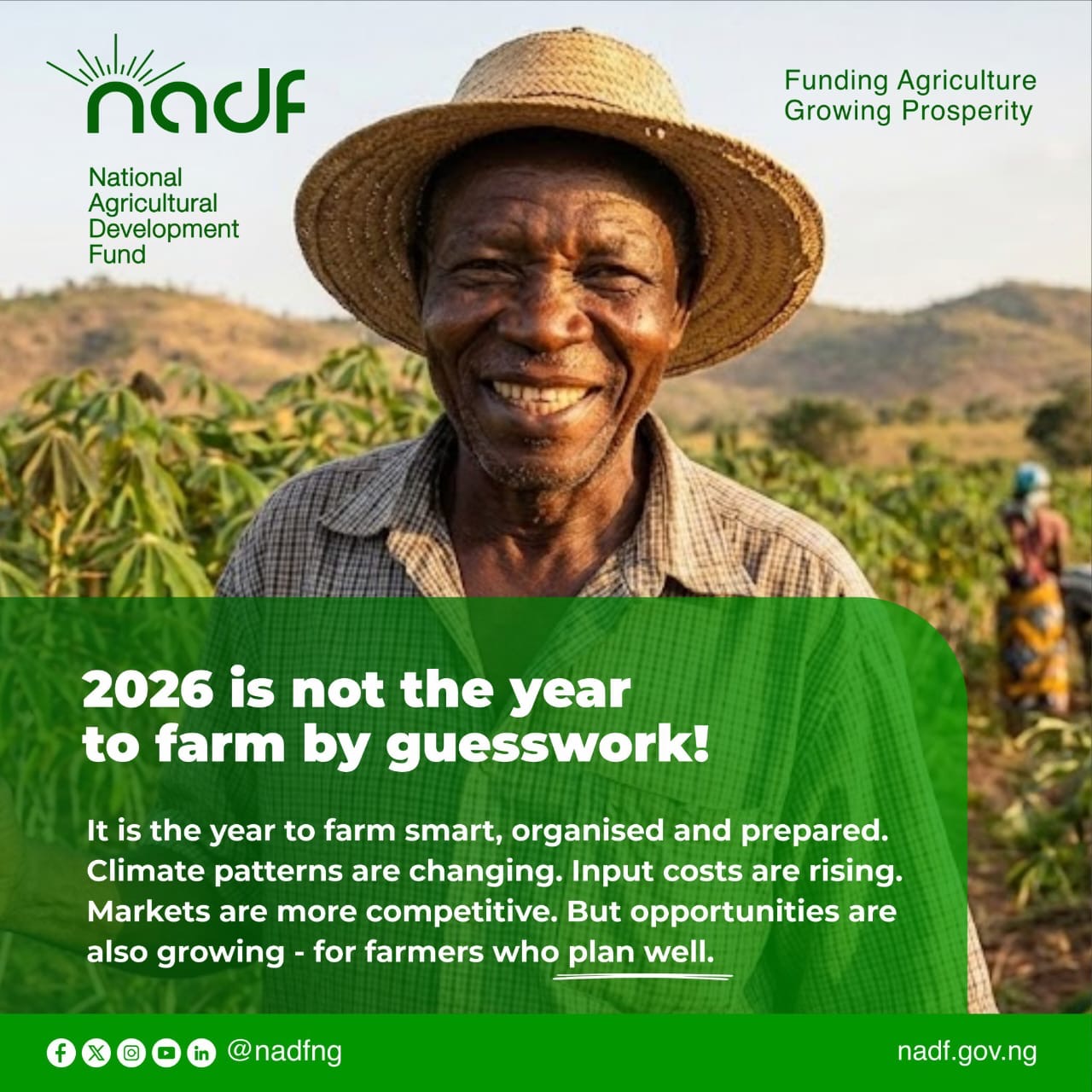




The Federal Government has outlined a mix of short, medium and long-term agricultural policies aimed at stabilising food prices, strengthening local production and restoring public trust in Nigeria’s food system.
This formed the focus of discussions at the Ministerial Policy Dialogue held during the Nigeria Public Relations Week in Kaduna, themed “Feeding Nigeria: Policy, Production and Public Trust.”
Representing the Minister of Agriculture and Food Security, Senator Abubakar Kyari, the Executive Secretary of the National Agricultural Development Fund (NADF), Mohammed Ibrahim, said the government’s current strategy centres on “market correction” to address food inflation and supply challenges.
He noted that targeted interventions, including the reduction of import tariffs on key agricultural inputs and commodities, have provided immediate relief by easing pressure on prices.
“Food prices this time last year were astronomically high, but some of the direct policies we introduced, especially around import tariff reductions, have helped stabilise the situation,” Ibrahim said.
According to him, the government is simultaneously pursuing policies to protect and strengthen domestic production, particularly through support for farmers and agro-processors.
“We have focused on farm input support programmes and agro-processing. We are providing subsidised inputs to processors with backward integration models. Strengthening both the farm and the factory is critical to ensuring agricultural policies succeed,” he added.
The NADF boss also highlighted ongoing tax and fiscal reforms targeting agricultural value chains, noting that food security now goes beyond production alone and includes communication, policy alignment and public engagement.
“Food security today is not just about agriculture. Clear communication, shaping narratives and influencing policy are equally important in building trust and ensuring impact,” he said
Providing an update on inflation trends, Ibrahim disclosed that food inflation has dropped to about 14 percent compared to 25 percent recorded in the same period last year.
“Food prices are beginning to abate, although challenges remain, particularly around the high cost of inputs. Farmers are still feeling the pressure,” he said.
To address these challenges, the government is implementing measures to liberalise mechanisation, improve access to inputs and deliver targeted support to farmers across key value chains.
“These interventions are beginning to yield results, and we expect inflation to continue on a downward trajectory,” he added.
Central to the government’s strategy is the role of the National Agricultural Development Fund, which is driving financing, policy implementation and institutional support across the sector.
Ibrahim in his goodwill message, outlined the Fund’s core functions, including strengthening food production across crops, livestock, fisheries and agro-forestry, as well as providing concessional financing to farmers and agribusinesses.
Other mandates include funding agricultural research, training and extension services, establishing state-level agricultural offices, and supporting emergency interventions such as disease outbreaks and input shortages.
The Fund is also working to expand rural financial inclusion by linking farmers with formal financial institutions and collaborating with international donor agencies to boost productivity.
Through its interventions, NADF has supported thousands of farmers nationwide.
Its Ginger Recovery, Advancement and Transformation for Economy Empowerment (GRATE) initiative has benefited over 5,000 farmers in Kaduna, Plateau and the Federal Capital Territory.
Similarly, Farm Input Support Programme (FISP) has reached 50,000 smallholder farmers across the six geopolitical zones, providing a 75 percent subsidy on seeds, fertilisers and crop protection products.
The Fund has also delivered emergency support to over 2,000 onion farmers affected by crises in Sokoto, Yobe, Borno and Kebbi states.
Looking ahead to the 2026 wet season, NADF is scaling up its fertiliser support programme under Renewed Hope Fertilizer Support Programme, targeting 127,000 farmers across 25 states and the FCT.
In terms of financing, NADF has mobilised billions of naira in partnerships with state governments and financial institutions to drive large-scale agricultural projects.
These include a N1.14 billion investment in ginger production in Kaduna State, a N5 billion co-financing arrangement with the Niger State Government for rice and maize cultivation, and multiple on-lending facilities to banks supporting fertiliser production, rice processing and cassava
value chains.
The Fund’s blended finance model has also helped attract additional private sector investment, reducing borrowing costs for agribusinesses and expanding access to credit. An example is its partnership with Psaltry International, IDH and a foundation, which empowered 15,000 young women in cassava cultivation in Oyo State.
At the sub-national level, NADF is collaborating with states such as Cross River, Jigawa and Katsina to develop risk-sharing mechanisms that will improve access to agricultural financing.
Ibrahim emphasised that all interventions are geared towards achieving food sovereignty and long-term food security in Nigeria.
“As we continue to implement these programmes, our goal is clear, to ensure that Nigeria can feed itself sustainably while creating economic opportunities across the agricultural value chain,” he said.

Stakeholders at the dialogue agreed that while progress has been made in reducing food inflation, sustained investment, policy consistency and effective communication will be critical to consolidating gains and building public trust in the sector.