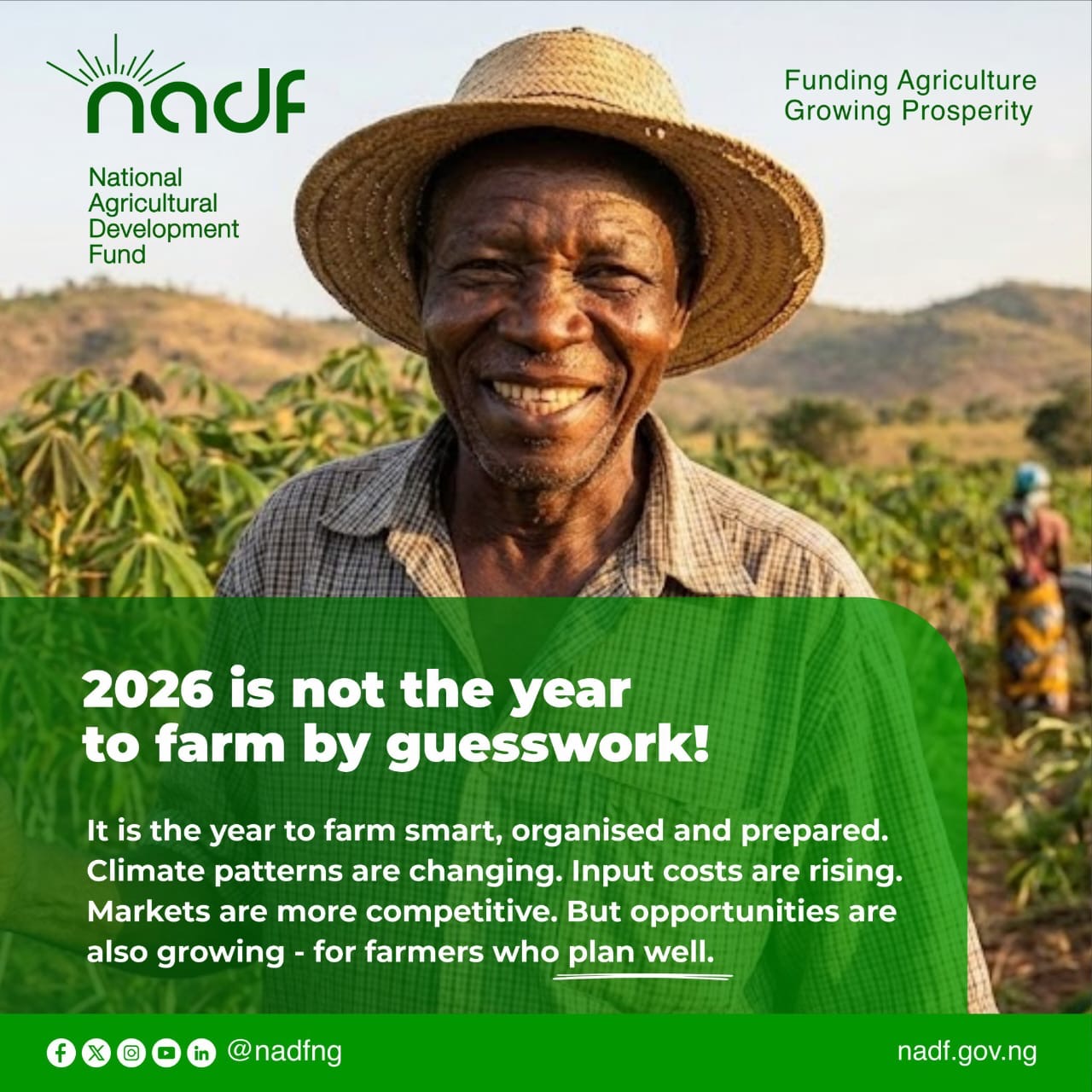




The National Agricultural Development Fund (NADF) on Tuesday in Abuja inaugurated a Blended Finance Programme and Working Group aimed at unlocking large-scale, affordable finance for Nigeria’s agricultural sector, with a strong focus on climate resilience and productivity.
The initiative, anchored and chaired by NADF, brings together public development finance institutions, commercial lenders, insurers and climate finance experts to design financing structures that reduce risk and expand credit to farmers and agribusinesses across priority value chains
Speaking at the event, Naona Usoroh, Head of International Partnerships at National Agricultural Development Fund, said the programme was created to bridge the long-standing gap between agricultural risk and the willingness of financial institutions to lend.
According to her, the blended finance framework will combine concessionary capital from public institutions such as NADF and other development banks with commercial lending, using risk-layering tools to make agriculture bankable at scale. “Our objective is to design, pilot and scale a blended finance programme that expands access to affordable, risk-adjusted credit for actors across agricultural value chains,” Usoroh said.
She explained that the programme would deploy instruments such as credit guarantees, pay-at-harvest index insurance, results-based finance mechanisms and technical assistance facilities. These, she noted, are intended to lower lending rates, protect financiers against losses and improve farmer resilience. “We are also looking closely at carbon revenue streams as part of a wider effort to align agricultural finance with Nigeria’s climate goals,” she added.
Usoroh said NADF would draw lessons from proven global blended finance models and existing market-ready products, adapting them to local realities. The aim, she stressed, is to scale solutions that have already demonstrated bankability and measurable development impact.
Delivering a keynote address, Chukwuma Kalu, Chief Executive Officer of Verdure Climate Services, said blended finance was no longer optional if Nigeria was serious about climate-smart agriculture.
“Agriculture employs millions and feeds the nation, yet it is one of the sectors most exposed to climate shocks,” Kalu said. “Climate-smart solutions exist, but they struggle to scale because of high upfront costs and the perception of risk. Blended finance is the tool that allows us to change that equation.”
He described blended finance as a catalytic mechanism that uses public and concessionary capital to crowd in private investment, rather than a subsidy. “Through blended finance, climate-smart agriculture becomes investable, scalable and inclusive, especially for smallholder farmers and agri-SMEs,” he said.
Kalu noted that the programme aligns with the AGRA 3.0 strategy, which places farmer resilience and access to finance at the centre of agricultural transformation. He added that it also offers practical benefits for financial institutions, particularly around sustainability reporting. “For many banks, agriculture is a major source of financed emissions, yet it is hard to measure and manage. This programme creates a pipeline of data-enabled projects with verifiable climate outcomes,” he said.
He explained that participation would allow lenders to track emissions reductions, reduce credit and climate risk through guarantees and insurance, and turn sustainability reporting into a strategic advantage rather than a compliance burden.
In a welcome address, Paul Fatona, Head of Agric at Leadway Assurance said risk management remained the missing link between capital and smallholder farmers. “This working group reflects our shared commitment to close that gap through innovation and collaboration,” he said.
Fatona described the partnership with AGRA and Verdure Climate as a platform to rethink agricultural finance. “By embedding insurance and climate analytics into financing structures, we can improve creditworthiness, unlock lending and enhance farmer resilience,” he said.
The Working Group will be co-chaired by the Bank of Agriculture, with Verdure Climate serving as technical secretariat and Leadway Assurance leading on insurance solutions. Stakeholders at the event said the structure signals a shift towards coordinated, market-driven solutions to Nigeria’s food security and climate challenges.

The programme’s pilot phase, scheduled for 2026, is expected to demonstrate how blended finance can mobilise domestic and international capital for climate-smart agriculture, with lessons to inform a national scale-up in the years ahead.